

Newsletter
November | 2024
“Change is inevitable, change is constant” (Benjamin Disraeli)
Contents:


Introduction by the Chair
As we reach the end of another season your Executive’s minds immediately turn to preparing for 2025. The ECB Officiating Department has recently undertaken a national consultation with County Cricket Boards (CCBs), and Regional and County ACOs regarding the future of officiating in the recreational game. Three distinct phases have been identified in the officiating journey: Recruitment, Conversion and Development, with plans for each.
Recruitment: the training of new officials; this would become the responsibility of the CCB (in our case LCF) who would organise the ECB New Officials Courses.
Conversion: making initial contact with new officials and signposting them to officiating opportunities would also be the responsibility of the CCB.
Development (& Retention): the ACO would be responsible, with support from the CCB, for appointing, observing and facilitating development including through the ECB Pathways and via a Continuing Professional Development (CPD) programme.
Having attended the Consultation sessions and discussed the matters raised as an Executive and with ECB and LCF, we are broadly in favour of the proposals and have already started considering our plans should this model be adopted.
Our view is that it has never been the responsibility of the ACO to recruit new officials. The game needs officials to survive and therefore their recruitment has always been a whole game responsibility. We feel that the changes proposed will make this clearer and that LCF, with its broader reach, is best placed to take on the responsibility for co-ordinating the approach to recruitment which the whole game needs to support. Last year LCF launched a new Young Officials programme which, with our support, has been a great success and we believe that this proves the concept. We look forward to continuing to work with LCF on this and other new officials’ initiatives in the years to come.
Having made the initial contact, it then makes sense for the County Board to signpost opportunities for all new officials. While we hope in many cases this will be to us and our local league organisations, some may need other opportunities, which as a member organisation we may struggle to provide, but which LCF is better placed to support.
This leaves the ACO to concentrate on what it does best, to provide services to its members to allow them to develop, be that via the ECB Pathways (organising appointments, observations etc for those interested), or by providing quality CPD either online or in person.
You are hopefully already aware of our online CPD modules which can be found on our website www.lancashireaci.wordpress.com/Training/CPD. We are currently in the process of developing a new, more professional and user-friendly website thanks to a very generous offer from one of our new members, Steve Briggs of XYP Media. I hope to have more news about his in our next Newsletter.
Given the geographical size of our county, we believe that “face to face” CPD is best delivered locally by our constituent League Umpires Associations and we are already working with them to develop a plan for the delivery of on-going CPD. Please make sure you engage with them and make your views known. LACO stand ready and willing to provide support to ensure that this CPD is of the highest quality and we will work with your league association to make sure this happen.
We consider that overall, the proposals should be welcomed. They depend upon close co-operation between LCF and LACO something which has improved significantly in recent years. Given goodwill on all sides we consider that the proposals will provide opportunities to improve recruitment and provide opportunities for all interested to achieve their potential.
I hope you are taking the opportunity to recharge your batteries after the rigours of the 2024 season, if you have any thoughts on any aspect of these proposals you can always contact me on rhales100@btinternet.com.
Enjoy the Newsletter.
Rob
Rob Hales – Chair LACO
2024 Winners and Runners-up
In case anyone hasn’t been looking on Play Cricket, the winners of our Leagues (in alphabetical order) were:
GMCL Premier League Winners: Edgworth; Runners-up: Roe Green
Premier League 2 Winners: Prestwich; Runners-up: Horwich RMI
Derek Kay 1st XI Cup Winners: Roe Green; Runners-up: Woodbank
T20 Winners: Shaw; Runners-up: Roe Green
Gtr Manchester Division 1 Winners: Manchester Stallions; Runners-up: Cheetham Gladiators
Amateur League Challenge Cup: shared between Rickshaw and Vertex
T20 Winners: Cheetham Gladiators; Runners-up: Edhi
Lancashire Cup: Ormskirk and Prestwich shared the Trophy
Lancashire League Division 1 Winners: Burnley; Runners-up: Darwen
Division 2 Winners: Ramsbottom; Runners-up: Walsden
Worsley Cup Winners: Lowerhouse; Runners-up: Todmorden
T20 Winners: Crompton; Runners-up: Clitheroe
Liverpool Competition Premier Division Winners: Ormskirk; Runners-up: Northern
First Division Winners: Colwyn Bay; Runners-up: Bootle
Ray Digman Winners: Ormskirk; Runners-up: Rainford
T20 Winners: Northern; Runners-up: Formby
Northern League Premier Division Winners: Fleetwood; Runners-up: Longridge
40 Over Cup Winners: Blackpool; Runners-up: Fleetwood
T20 Winners: Blackpool; Runners-up: Garstang
North-West CL Premiership Winners: Blackrod; Runners-up: Little Lever
Division 1 Winners: Read: Runners-up: Atherton
Hamer Cup Winners: Read; Runners-up: Little Lever
T20 Winners: Blackrod; Runners-up: Lostock
Palace Shield Premier Division Winners: Barrow; Runners-up: Thornton Cleveleys
Meyler Cup Winners: Thornton Cleveleys; Runners-up: Morecambe
T20 Winners: Carnforth; Runners-up: Thornton Cleveleys
Southport & District Premier Division Winners: Prescot & Odyssey; Runners-up: Irby
Sandhurst Shield Winners: Irby; Runners-up: Goose Green
Westmorland League Division 1 Winners: Burneside; Runners-up: Appleby Eden
Hackney & Leigh Winners: Burneside; Runners-up: Lindal Moor
Barrow CC
In a previous newsletter we mused upon the fact that the Ribblesdale League was won in 1923 by Barrow. Was this Barrow-in-Furness?
I came across a report of an end of season match in 1929 between Barrow and Read “two teams fighting hard for victory on turf that was highly treacherous (Get the Game On!) and well besprinkled with sawdust” which confirms that it was not Barrow-in-Furness, and indeed it was the village near Whalley. It was a bottom of the table match with Read, condemned to bottom place and applying for readmission for the first time in their history. With nothing at stake, the author said “the teams played on sodden ground, the bowlers carried sawdust about, and the batsmen hammered the crease just because they are in love with the game. Clearly the spirit of cricket has not yet gone out of the villages.” Read’s readmission was seen as “as a mere formality since every other club admires the plucky way the villagers face up to rivals much more richly endowed.”
95 years on, Read won Division 1 of the North-West Cricket League and will play in the Premier Division next season.
Suresh Patel Obituary

Photo by Harry McGuire
The North West Cricket League Umpires and Scorers Association was saddened to learn that a well -respected umpire and scorer Suresh Patel, had passed away after a long illness, very bravely fought. Suresh was one of the nicest people you could ever meet. He would do anything for anyone, always greeting people with a smile and a hug or handshake.
He loved his own family and his cricketing family so much. He was very well respected throughout the cricketing world and was known to some “as the man of a thousand handshakes”. At one game in the Bolton Cricket League many years ago, Suresh was still shaking hands with spectators, whilst his colleague and players were waiting for him out on the field ready to start the game.
He knew every tea lady and always greeted them by name. He loved a good cup of tea with biscuits and a piece of fruit. He greeted all the females as young lady, no matter their age. When he was asking how people were he would always refer to them as Mr or Mrs and the surname. He was such a gentleman, who respected others.
He was born in Tanzania in 1955 and moved to India with his parents in 1964. Between the ages of 15 and 20 , he played cricket and was a left arm pace bowler and a reasonable batter. He came to England in 1976.
In the 1980s he used to drive the bus for Deane and Derby CC, taking the players all over the country to places like London, Huddersfield, Leicester and Blackburn to name a few.
The family owned a box van which was used for the cash and carry trips, so they added some bus seats lengthways so that Suresh could drive the kids to cricket matches. At this time he played for GM Buses and he also drove the team up and down the country.
Suresh was on the Executive committee of the Bolton Cosmopolitan League for a good number of years which is where he started to umpire around 1990. Then in 2005 the late Fred Elmore encouraged him to take his first of many umpiring exams and join the Bolton Umpires & Scorers Association.
This led to him standing as umpire in many formats of cricket, like the Indoor comps at Old Trafford, around the local cricket leagues, the Anthony Axford’s Indoor comp, County Age Group cricket for girls and boys, the Universities and local college games and Floodlight cricket. He also stood in many LKO and NKO matches, Village Cup matches and Inter-league & District matches to name a few. If he could umpire 7 days a week he would.
He started to umpire a girls indoor comp at Blackburn and after making many friends, he was then asked to officiate with another colleague, at an Outdoor Ladies festival in Tarleton which had a group of umpires. This was an honour for him.
Whilst he was having treatment, he couldn’t umpire, so in January 2024 he came to the Anthony Axford indoor comp and was helping with the scoreboard. He loved to help anyone. Then at the U13s indoor comp final around February/March 2024, he came and handed out the medals to all the players in the winning team. It was so nice to see the smile on his face, doing what he loved doing, being part of a game of cricket whichever way he could.

Suresh was always trying to better himself. He would come to as many Umpire or Scorers training courses as he could to refresh and gain extra knowledge. Suresh was a Qualified Umpire, Qualified Scorer and Qualified Level 2 Coach. He sat with an experienced scorer many times learning how to electronically score. He loved learning new ways of doing things in cricket.
Suresh was fantastic with the junior players. He would offer his help and advice to any player on the field, if it helped them improve their batting or bowling, no matter what team they were playing for. The juniors players respected and listened to him. He knew most the parents as well as the players and would always ask how they were doing at their clubs when he came across them at another game. His memory was amazing. He seemed to know everyone’s name.
When he was coaching the cubs (youngest age group) at Astley Bridge CC, every other group would have packed up at 8pm, but not Suresh. Only when it was too dark to count the kids would he bring them in. He just loved being out there, sharing his knowledge and watching the kids enjoying themselves.
We all talk about cricket being a family. Judging from the number of colleagues , umpires players, scorers , club officials and volunteers who attended his funeral this was a true representation of that. He will certainly be missed around the Lancashire area as he was a very popular and well respected umpire and a friend to many throughout the County.
Karen Knott
Secretary NWCLOA
West Lancashire Cricket Society
For anyone wanting to attend talks on cricket the WLCS winter programme is a must.
On Wednesday November 6th, Kate Cross of Lancashire, and England (as well as Brisbane Heat and Royal Challengers Bangalore) will provide a fascinating view on the development of the women’s game in recent years.
Our final event of the calendar year involves one of England’s bright hopes for the 2010’s, James Taylor. He was forced to cut short his career due to a heart condition but has stayed in the game as National Selector for England and now a coach.
Our January 2025 speaker is Paul Farbrace. Following a playing career with Kent and Middlesex, he has coached in almost every major playing country, most notably with England, and is currently Head Coach at Sussex.
In February we will be visited by David Shortt, Deputy Head Groundsman at Emirates Old Trafford. He will give us an insight into the challenges of maintaining the pitch within the ground’s varied calendar, as well as the club’s use of out grounds like Southport & Birkdale and the ongoing project at Farrington.
Finally, to complete the programme, a genuine legend of English cricket, Graham Gooch of Essex and England will be the speaker for our annual dinner. No need for a pen picture of his achievements.
All these events are open to the general public for a cost of £8, although there is no charge for your first meeting. You can join the society for an annual subscription fee of £30 (£40 for joint membership), which gives you free entrance to the events. The annual dinner is an extra cost, to be confirmed.
Meetings take place at Southport & Birkdale Cricket Club. More information can be found https://wlcs.org.uk/
Regular Meetings at Unsworth Cricket Club with guest speakers
Meetings held at Unsworth Cricket Club usually on the first Thursday of the month (October to April) but the January meeting this time will be on the ninth.
5th December Guest speaker former Test match umpire John Holder.
9th January Guest speaker John Farrell
6th February Guest speaker Ian Herbert
6th March Guest speaker Hughie Evans
3rd April Guest speaker Malcolm Venn – the Lancashire Education Officer will speak
about any new Laws and any problems you have with cricket.
Unsworth C. C.
Pole Lane
Unsworth
Latest Scorer Information
As the method of training umpires is changing so will the way to become a scorer but not until winter 2025. A new online introduction to scoring should be in place by October 2025 and other courses will follow.
Courses available that can be run during this winter are:
Introduction to Scoring: The aim of this course is to provide you with the basic skills and knowledge to record a cricket match. It won’t teach you everything you need to know, but it will give you the tools and confidence to get started. Topics covered include completing a scoring record, recognising umpire’s signals, standard scoring symbols and scoring on paper.
Introduction to Play Cricket App (phones/tablets) training:
This course covers scoring on the app, downloading fixtures, making edits to entries without deleting data, how to finalise results, using DLS within the app and looks at the limitations of the app. It does not cover the basics of scoring or the laws of cricket. This course is suitable for people who already know how to score manually and wish to score via a phone/tablet for pitch sideline scoring, ideal for junior cricket.
Electronic Scoring via PCS Pro (laptop):
This course covers scoring on the laptop, downloading fixtures, making edits to entries without deleting data, how to finalise results, how to use DLS within the software, where to find stats information and highlights the settings required for connection to social media and scoreboards. It does not cover the basics of scoring or the laws of cricket. This course is suitable for people who already know how to score manually and wish to score electronically, usually senior cricket teams.
Club Scorer (leading to Level 1):
The course for anyone wanting scoring on a regular basis and is the only one to comprehensively teach you how to score. This course is suitable for complete beginners and existing scorers who want to fine tune their skills
Duckworth Lewis Stern (DLS):
The course is for anyone who would like to know an in-depth background to DLS and how to use it. This module is for scorers who are wishing to progress through the pathway.
A session on DLS specifically for umpires can be run should leagues would like some training on this area.
Linear course
This is a way of having a backup if scoring by lap top and is very useful if there is an electronic failure
Keep an eye out on the LACO website for dates of such courses or contact Karen Knott CSO at Knott_karen@hotmail.com
Duck or Grouse?
I an Pendlebury writes that he was umpiring a game at Leyland cricket club Fox Lane on the 18th of July 2024 between Leyland Ladies v Hightown Hurricanes. Two ladies’ sides in a Lancs T20 on a Wednesday evening.
I’ve done many ladies games and am familiar with the format and know most of the ladies so what can possibly go wrong?
I’ve had my share of problems on the cricket field but my problem this particular evening was a duck, not the score of zero variety that plagued my playing career but the female mallard variety.
Standing at square leg with my colleague Paula Johnson from Skelmersdale at the bowler’s end, the aforementioned mallard glided in to execute a perfect landing between me and the batter on strike. No problem so far, it’s soon going to realise there’s nothing here for her and fly off. Two more deliveries and Paula calls over, I walked past the duck and make a poor joke about the duck being one of the quota of Leyland fielders in the fielding circle. The duck obviously enjoyed this quip so decided to follow me to the bowler’s end, I took my position and held my arm out while the batter got ready for the first delivery. The duck stood at the side of me quacking and looking up at me. I couldn’t quite believe how tame this animal was.
Most of the girls had started laughing by now but I decided we had a game to get on with, so I naively told the bowler, Charlotte Whitaker, to just ignore it. ” I can’t, it’s on my run up ” she laughingly protested. ” You’ll have to take it off the field Ian ” laughed Abi Bates, the Leyland captain.
In my school days, I worked on a chicken farm and was used to handling live birds, but this is nearly 40 something years later and there’s no way I’m entertaining the players and spectators by getting pecked and covered in muck and feathers but the duck is going nowhere. I’m trying to think how this is going to play out. If I walk off, who is going to umpire the game? Is this a practical joke? How can it be? Why is this stupid duck bothering me? And why here and now? Eventually, reluctantly, I decided I was the one who had to leave so, like some wild fowl security guard, I slowly and embarrassingly escorted the bird to the boundary. Once there, it wasn’t over, I turned to return but the duck wasn’t going to be tricked that easily and immediately followed me back on, much to everyone’s amusement. I turned back and used some stern words that seemed to do the trick as she then wandered off.
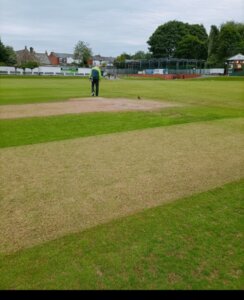
Paula, my colleague was kind enough to record the incident but only managed a still image so at least it won’t end up being circulated too widely.
The Origins of Cricket at Haslingden
I came across a slim volume The Haslingden Club in the Victorian Era written by Chris Aspin and published by the Helmshore Local History Society in 1976. It tells of the formation of the club in 1853 by local mill owners, landowners and professional men. You wouldn’t know it now, but the club’s ground was part of the estate of the Townsend family who had been landowners for over 200 years and who had diversified into cotton spinning as well as being founder members of the cricket club.
 The club had strict rules – any player making himself unavailable for 3 successive games was fined 1s (just over £5 today). Matches started against familiar names Accrington, Lower House (that’s how it was spelled), Darwen, Bacup, Church and Rawtenstall, and less familiar Blackburn Britannia.
For the first few years working men were not allowed to join the club. Instead they set up two rival clubs Newhallhey (in Rawtenstall) and Haslingden Laund Hey who played on the top of this hill at 1100 feet, which had previously been used for horse racing in the Georgian era and more recently the gentry used it for hare coursing. Laund Hey was good enough in 1863 to record wins against Haslingden, Lower House, Bacup, Stacksteads Albion, Water and Lytham. The Haslingden club relaxed its ban on working men and most of the players moved to Bentgate for 1866, taking their pavilion with them which was bought by Haslingden as part of the improvement of ground and facilities, necessary as they now had a professional and charged admission. The ground was divided into upper and lower halves, with admission for the better off in the upper half costing twice as much as the popular seats with the segregation effected by the erection of large boards. Public interest took off in the 1870s particularly for the derby matches between Haslingden and Bacup.
The games were officiated by club umpires and in 1865 it all kicked off when Bacup players disputed decisions and the crowd became unpleasant. Bacup refused to play on unless the Haslingden umpire, James Smith, was replaced. Smith said “I have officiated for the Haslingden club on several occasions against such respectable clubs as Church, Burnley, Clitheroe, Over Darwen, Ramsbottom, Bolton and other places, but never to my recollection or to that of our respected players was I ever accused of showing partiality to my own club. The conduct of the Bacup players was not to be called gentlemanly on this occasion. They know, or ought to have known, the laws of cricket without bringing the match to so speedy a termination.” Five days after the game, the secretary of Haslingden wrote to Bacup demanding the return of the match ball. The clubs didn’t play each other again for 3 years.
In 1877 the crowd at Bentgate was a record 1300 and the clubs brought in ringers for these big games, Bacup recruiting George Ulyett (England and Yorkshire) for the 1880 away fixture. That day Haslingden employed his county colleague Ephraim Lockwood who dismissed Ulyett with his third ball for 17 and scored 50 out of 74 to give Haslingden a 4 wicket win. By the 1880s the crowd had swelled to over 4000 and special cricket trains were run between the towns to get the workers to the cricket as soon as the machines went quiet at lunchtime.
In 1882 the Haslingden batsman JT Pinder was on 49 (one run away from a substantial collection) when he struck the ball powerfully to square leg where it struck the umpire, George Whittle, on the head. No run was scored and Pinder was out immediately afterwards. Whittle recovered but there was to major controversy when he gave Bacup’s professional Myers run out. The Bacup captain walked on to the field and remonstrated with the umpire who immediately resigned his office, the game resuming with a new umpire.
Until the 1889 season teams were not permitted to declare and had to bat till they were all out. Burnley’s 525/7 at Bacup in 1888 may have influenced the rule change.
In 1887 Haslingden won the Lancashire Cricket Association Amateur Cup, a competition modelled on football’s FA Cup. The competition had first taken place in 1885 – has anyone told the LCF that next season will be the 140th anniversary of the first Lancashire Cup? In the last 16 Haslingden 127/4 beat Accrington 87, in the Quarter-final Ordsall Hall 177-83 before a large crowd saw them reach the final by beating local rivals Bacup (153/4 played 134). The final was played at Alexandra Meadows where they came up against cup-holders Church in a two innings game. The game started on Saturday August 13th and would continue on the following Monday and Wednesday. In front of 2000 spectators Church scored 271, with the last pair adding 67. At the close on Saturday, Haslingden were 95/3 in reply. On the Monday Haslingden were all out for 231 before bowling out Church for 138. Set 179 to win they were 100/4. The game resumed on Wednesday in pouring rain in front of only 300 people, but Haslingden reached their target for the loss of one further wicket when the previously mentioned Pinder hit the ball out of the ground and the batsmen ran three (no sixes in those days!)

The winning team returned home on a waggonette drawn by 6 horses to be met a huge crowd including the rifle band who played “Rule Brittania”. The team had a celebratory meal at the Commercial Inn as the town celebrated. The players included a Blackburn Rovers footballer, a cotton twister, a tinsmith and a Local Government Officer. In October 1890, 13 clubs agreed to form the North East Lancashire League. After its first season the League was renamed the Lancashire Cricket League and the rest is history.